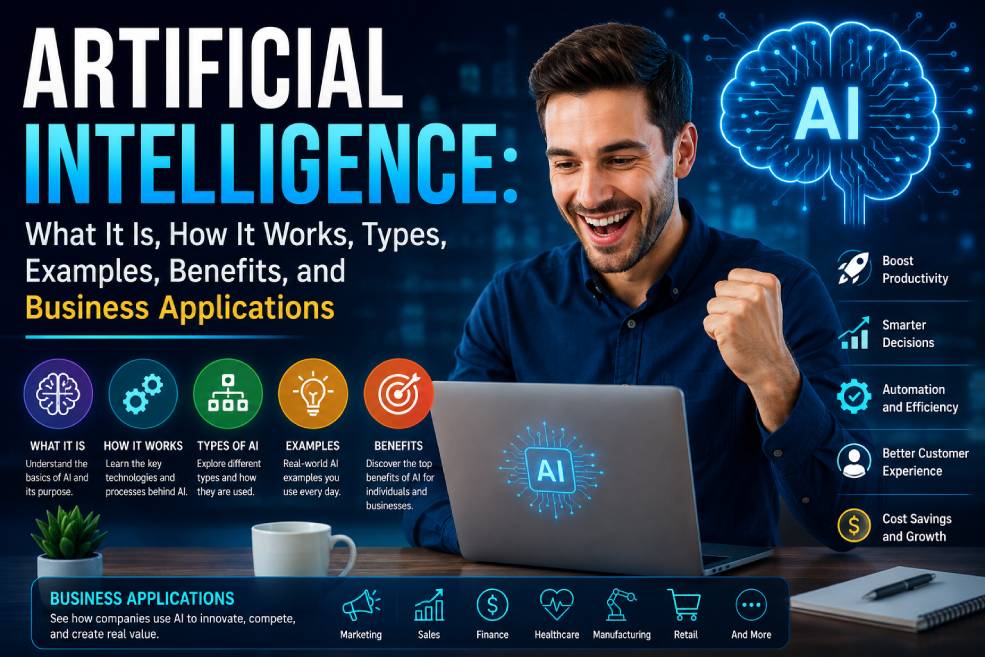
Artificial Intelligence, also known as AI, is one of the most important technologies of our time. It is changing how people search for information, write content, build software, analyze data, serve customers, create images, detect fraud, recommend products, study, work, and make decisions.
But despite all the attention around AI, many people still have a simple question:
What is Artificial Intelligence, really?
Some people think AI is a robot. Others think it is only ChatGPT, image generators, self-driving cars, or automation software. In reality, Artificial Intelligence is much broader. It is a field of computer science focused on creating systems that can perform tasks that usually require human intelligence, such as understanding language, recognizing patterns, learning from data, making predictions, recommending actions, solving problems, and generating new content.
The OECD describes an AI system as a machine-based system that can, for explicit or implicit human-defined objectives, infer from inputs how to generate outputs such as predictions, content, recommendations, or decisions that can influence physical or virtual environments.
That definition is important because it shows that AI is not only about machines “thinking like humans.” It is about systems that process information, identify patterns, and produce useful outputs.
For businesses, AI is no longer just a futuristic concept. It has become a practical tool for productivity, automation, customer service, marketing, sales, operations, software development, cybersecurity, finance, healthcare, education, logistics, and decision-making. Stanford’s 2025 AI Index reported that business use of AI accelerated significantly, with 78% of organizations reporting AI use in 2024, up from 55% the year before.
This guide explains Artificial Intelligence in a clear, complete, and practical way. You will understand what AI is, how it works, the main types of AI, real-world examples, major benefits, business applications, risks, and how companies can start using AI strategically.
🧠 What Is Artificial Intelligence?
Artificial Intelligence is the ability of a computer system to perform tasks that normally require human intelligence.
These tasks can include:
🧠 Learning from information
👁️ Recognizing images
🗣️ Understanding language
📊 Finding patterns in data
🎯 Making predictions
🤖 Automating decisions
✍️ Generating text
🎨 Creating images
💬 Answering questions
🧩 Solving problems
A simple way to understand AI is this:
Artificial Intelligence allows machines to process information and produce intelligent results.
Traditional software follows fixed rules created by programmers. For example, a developer might write:
“If the user clicks this button, show this message.”
AI is different because it can learn patterns from data. Instead of programming every possible rule manually, developers train AI systems using examples. The system then uses those patterns to make predictions, classifications, recommendations, or generated outputs.
For example, instead of manually writing thousands of rules to identify whether an email is spam, an AI model can learn from millions of emails labeled as “spam” or “not spam.” Over time, it learns patterns such as suspicious wording, sender behavior, links, formatting, and repetition.
That is why AI is powerful. It can handle complexity that would be difficult or impossible to manage with traditional rule-based programming.
⚙️ How Artificial Intelligence Works
Artificial Intelligence works by combining data, algorithms, models, computing power, and feedback.
The process usually follows these stages:
1. Data Collection 📥
AI needs data to learn.
This data can include:
Text
Images
Videos
Audio
Transactions
Customer behavior
Sensor data
Website activity
Medical records
Financial records
Product data
Support tickets
The quality of the data matters a lot. If the data is incomplete, biased, outdated, or inaccurate, the AI system may produce poor results.
This is one of the most important ideas in AI:
Better data usually leads to better AI.
A company that wants to use AI successfully must first understand what data it has, where that data is stored, whether it is clean, and whether it can legally and ethically be used.
2. Data Preparation 🧹
Raw data is often messy.
It may contain duplicate records, missing values, inconsistent formats, spelling errors, irrelevant information, or outdated entries. Before training an AI model, the data usually needs to be cleaned, organized, labeled, and structured.
For example, if a company wants to train an AI model to predict customer churn, it may need to organize data such as:
Customer age
Subscription plan
Purchase history
Support requests
Cancellation behavior
Payment delays
Product usage
Customer satisfaction scores
The AI model learns from these patterns. If the data is confusing, the model will also be confused.
3. Model Training 🏋️
Training is the process where an AI model learns from data.
A model is like the “brain” of the AI system. During training, the model analyzes examples and adjusts its internal parameters to improve performance.
For example, an image recognition model may be shown thousands or millions of images of cats, dogs, cars, buildings, products, or medical scans. Over time, it learns visual patterns that help it identify similar objects in new images.
A language model is trained on large amounts of text to learn grammar, context, facts, reasoning patterns, writing styles, and relationships between words and ideas.
The model does not learn exactly like a human. It learns statistically. It finds patterns in data and uses those patterns to produce outputs.
4. Inference 🎯
Inference is when the trained AI model is used in the real world.
After training, the model receives a new input and produces an output.
Examples:
A customer asks a chatbot a question → the AI generates an answer.
A user uploads a photo → the AI identifies objects in the image.
A bank receives a transaction → the AI estimates fraud risk.
A store visitor browses products → the AI recommends what to buy.
A manager uploads a spreadsheet → the AI summarizes trends.
Training is where the model learns. Inference is where the model works.
5. Feedback and Improvement 🔁
AI systems often improve through feedback.
If users correct answers, rate responses, approve suggestions, reject recommendations, or provide new examples, the system can be improved over time.
In business, this feedback loop is essential. An AI system should not be treated as a one-time installation. It should be monitored, evaluated, improved, and governed.
🧩 Main Types of Artificial Intelligence
Artificial Intelligence can be classified in several ways. The most useful classification for business and general understanding includes narrow AI, general AI, machine learning, deep learning, generative AI, predictive AI, and agentic AI.
1. Narrow AI 🎯
Narrow AI is AI designed to perform a specific task.
Most AI systems today are narrow AI.
Examples include:
Spam filters
Recommendation systems
Voice assistants
Chatbots
Image recognition tools
Fraud detection systems
Translation tools
AI writing assistants
Medical image analysis systems
Narrow AI can be extremely powerful within its specific area, but it does not have general human understanding. A model trained to recognize faces cannot automatically manage warehouse logistics. A fraud detection model cannot automatically write legal contracts. A chatbot cannot automatically drive a car.
It may appear intelligent, but it is still limited to the task and data it was designed for.
For businesses, narrow AI is often the most practical and profitable type of AI because it solves specific problems.
2. Artificial General Intelligence 🌐
Artificial General Intelligence, often called AGI, refers to a hypothetical type of AI that could understand, learn, and perform a wide range of intellectual tasks at a human-like or greater-than-human level.
AGI would not be limited to one task. It would be able to transfer knowledge across domains, reason broadly, adapt to unfamiliar situations, and learn new skills with flexibility.
Current AI systems are not generally considered full AGI. Today’s models can be impressive, especially in language, coding, summarization, and creative tasks, but they still have limitations. They can make mistakes, misunderstand context, hallucinate information, lack real-world grounding, and require human oversight.
For businesses, the most important point is this:
You do not need AGI to create value with AI.
Companies are already saving time, improving operations, and building better products with narrow AI, machine learning, automation, and generative AI.
3. Machine Learning 📊
Machine Learning is a branch of AI that allows systems to learn from data instead of relying only on fixed rules.
In traditional programming, a human writes rules.
In machine learning, the system learns patterns.
Example:
Traditional rule:
“If a transaction is above $5,000 and happens in another country, mark it suspicious.”
Machine learning approach:
“Analyze thousands or millions of past transactions and learn which patterns are associated with fraud.”
Machine learning is used in:
Credit scoring
Demand forecasting
Fraud detection
Customer segmentation
Product recommendations
Predictive maintenance
Pricing optimization
Medical diagnosis support
Marketing personalization
Machine learning is especially useful when the problem involves patterns that are too complex for manual rules.
4. Deep Learning 🧠
Deep Learning is a type of machine learning based on artificial neural networks with many layers.
These systems are inspired loosely by the structure of the human brain, but they are mathematical models, not biological brains.
Deep learning is especially strong in areas such as:
Computer vision
Speech recognition
Natural language processing
Image generation
Voice synthesis
Autonomous systems
Large language models
Deep learning became more powerful because of three major factors:
More data
Better algorithms
More computing power
For example, deep learning can help a system recognize objects in photos, transcribe speech, translate languages, detect defects in manufacturing, or generate realistic images.
5. Generative AI ✍️
Generative AI is AI that creates new content.
It can generate:
Text
Images
Code
Audio
Video
Presentations
Product descriptions
Marketing copy
Emails
Reports
Design concepts
Summaries
Generative AI became widely known through tools that can answer questions, write articles, create images, generate code, and assist with research.
For businesses, generative AI is one of the most accessible forms of AI because employees can use it directly in daily tasks.
Examples:
A marketing team uses AI to draft ad copy.
A support team uses AI to summarize tickets.
A developer uses AI to generate code suggestions.
A manager uses AI to create meeting summaries.
A sales team uses AI to personalize outreach emails.
A designer uses AI to create visual concepts.
Generative AI is powerful, but it must be reviewed. It can produce incorrect information, biased outputs, generic content, or confident mistakes. Human judgment remains essential.
6. Predictive AI 🔮
Predictive AI uses data to estimate what is likely to happen.
It answers questions like:
Which customer is likely to cancel?
Which product will sell more next month?
Which transaction may be fraudulent?
Which machine may fail soon?
Which lead is most likely to buy?
Which patient may need extra attention?
Which delivery route is most efficient?
Predictive AI is valuable because businesses are constantly making decisions under uncertainty.
A company that can predict demand better can reduce waste.
A bank that can predict fraud better can reduce losses.
A retailer that can predict customer behavior can personalize offers.
A factory that can predict equipment failure can avoid downtime.
Predictive AI does not guarantee the future. It estimates probability. That is why businesses should use it as decision support, not blind automation.
7. Agentic AI 🧭
Agentic AI refers to AI systems that can take steps toward a goal with a degree of autonomy.
Instead of only answering a question, an AI agent may plan a task, use tools, search data, call APIs, update systems, send messages, or complete multi-step workflows.
Example:
A normal chatbot may answer:
“Here is how to create a report.”
An AI agent may:
Find the data, analyze it, generate the report, format it, save it, and notify the team.
Agentic AI is becoming increasingly important in business, but it also requires stronger governance. McKinsey’s 2025 Global Survey described a market where AI use continues to expand, including growing interest in agentic AI, while many organizations still struggle to move from pilots to scaled business impact.
For companies, agentic AI should be introduced carefully. The more autonomy an AI system has, the more important it becomes to define permissions, review points, security rules, and human approval.
🌍 Real-World Examples of Artificial Intelligence
Artificial Intelligence is already present in daily life, often in ways people do not notice.
Search Engines 🔎
Search engines use AI to understand queries, rank results, detect spam, interpret intent, and personalize results.
When you search for something, the system does not simply match exact words. It tries to understand meaning, relevance, authority, freshness, and user intent.
Recommendation Systems 🛒
Streaming platforms, e‑commerce stores, music apps, and social networks use AI to recommend content or products.
Examples:
Movies you may like
Products frequently bought together
Songs based on your taste
Videos similar to what you watched
Articles related to your interests
Recommendation systems are one of the most profitable uses of AI because they influence engagement, retention, and sales.
Virtual Assistants 💬
AI assistants can answer questions, create reminders, generate text, summarize documents, translate languages, and help with tasks.
Modern assistants are increasingly used in business for productivity, customer support, internal knowledge search, and workflow automation.
Fraud Detection 🛡️
Banks and payment platforms use AI to detect suspicious activity.
AI can analyze transaction patterns, location, device behavior, purchase history, timing, and anomalies to estimate fraud risk.
This is useful because fraudulent behavior often changes quickly. Machine learning can adapt better than rigid rule systems.
Healthcare 🏥
AI can support healthcare by helping analyze medical images, organize records, identify risk patterns, assist research, and improve administrative workflows.
AI should not replace qualified medical professionals. Its best role is often to support doctors, nurses, administrators, and researchers with better information and faster analysis.
Manufacturing 🏭
Factories use AI for quality control, predictive maintenance, robotics, supply chain planning, and defect detection.
For example, computer vision can inspect products on a production line and detect flaws faster than manual inspection in some contexts.
Education 📚
AI can help students and teachers through personalized learning, automated feedback, tutoring systems, translation, study planning, quiz generation, and accessibility tools.
The best educational use of AI is not replacing teachers. It is helping people learn better, faster, and with more personalization.
Marketing 📣
AI helps marketers analyze audiences, generate content ideas, personalize campaigns, optimize ads, segment customers, and predict conversion behavior.
A marketing team can use AI to create drafts, but human creativity and brand judgment are still essential.
Software Development 💻
AI coding assistants help developers write code, debug errors, explain functions, create tests, refactor code, and document systems.
This does not eliminate the need for developers. It changes the workflow. Developers who understand architecture, logic, security, and product goals become even more valuable when they use AI well.
💼 Business Benefits of Artificial Intelligence
Artificial Intelligence can create value in many ways. The strongest benefits usually appear when AI is connected to a clear business problem.
1. Productivity Gains ⚡
AI can reduce repetitive work.
Examples:
Summarizing long documents
Drafting emails
Creating reports
Analyzing spreadsheets
Transcribing meetings
Generating first drafts
Classifying support tickets
Extracting information from files
This allows employees to focus more on strategy, creativity, customer relationships, and decision-making.
The goal is not simply “doing things faster.” The real goal is freeing human attention for higher-value work.
2. Better Decision-Making 📊
AI can help leaders make decisions based on data instead of guesswork.
Examples:
Sales forecasts
Customer churn prediction
Inventory planning
Risk scoring
Market analysis
Financial modeling
Operational dashboards
AI can reveal patterns that humans might miss. But it should not replace human responsibility. A good decision combines data, business experience, ethics, and context.
3. Cost Reduction 💰
AI can reduce costs by automating tasks, improving accuracy, preventing losses, and optimizing resources.
Examples:
Reducing support workload
Preventing fraud
Optimizing delivery routes
Reducing inventory waste
Automating document processing
Detecting defects early
Reducing downtime in machines
Cost reduction is one of the clearest business cases for AI, but it works best when the process is already understood. Automating a broken process can make the problem worse.
4. Better Customer Experience 😊
AI can improve customer experience by making service faster, more personalized, and more available.
Examples:
24/7 chat support
Personalized recommendations
Faster ticket routing
Automated order updates
Intelligent FAQ systems
Personalized onboarding
Customer sentiment analysis
Customers do not care whether the company uses AI. They care whether their problem is solved quickly and respectfully.
AI should make the experience smoother, not colder.
5. More Personalization 🎯
AI can personalize content, products, offers, recommendations, and communication.
Examples:
An online store recommends products based on behavior.
A learning platform adapts lessons to each student.
A bank offers personalized financial insights.
A streaming service recommends shows.
A marketing platform changes messages by customer segment.
Personalization can increase engagement and conversion, but it must respect privacy and avoid becoming invasive.
6. Faster Innovation 🚀
AI can accelerate product development, research, design, prototyping, and testing.
Examples:
Generating product ideas
Creating interface prototypes
Analyzing customer feedback
Testing marketing messages
Finding trends in reviews
Helping developers build faster
Creating synthetic examples for testing
AI can shorten the distance between idea and execution.
7. Competitive Advantage 🏆
Companies that use AI strategically can move faster than competitors.
They can understand customers better, automate operations, reduce waste, launch products faster, and make decisions with more confidence.
However, AI alone is not a competitive advantage forever. As tools become widely available, the real advantage comes from:
Better data
Better workflows
Better leadership
Better integration
Better customer understanding
Better execution
AI is a multiplier. It multiplies the quality of the strategy behind it.
🏢 Business Applications of Artificial Intelligence
AI can be applied across almost every department of a modern company.
1. AI in Customer Service 💬
Customer service is one of the most common areas for AI adoption.
AI can help with:
Chatbots
Ticket classification
Answer suggestions
Sentiment analysis
Complaint detection
Knowledge base search
Call summaries
Automated follow-ups
A good AI customer service system does not simply “replace humans.” It handles repetitive questions and gives human agents better tools.
Example:
A customer asks, “Where is my order?”
The AI can check the order status, provide the delivery estimate, and send a tracking link. If the customer is angry or the issue is complex, the system can escalate to a human agent.
This improves speed without removing human care.
2. AI in Marketing 📣
Marketing teams use AI to understand audiences, create content, optimize campaigns, and analyze performance.
AI can help with:
Blog outlines
Ad copy
Email campaigns
SEO research
Content calendars
Customer segmentation
A/B testing ideas
Social media captions
Trend analysis
Conversion optimization
For example, an AI system can analyze which headlines perform better, which audience segments convert more, and which topics generate more engagement.
But AI-generated marketing should not feel generic. The best results come when humans add brand voice, emotion, originality, and market knowledge.
3. AI in Sales 🤝
Sales teams can use AI to prioritize leads, personalize messages, summarize calls, and identify opportunities.
AI can help with:
Lead scoring
CRM updates
Sales forecasting
Email personalization
Call transcription
Proposal drafts
Objection analysis
Follow-up reminders
Customer research
Example:
Instead of treating every lead equally, AI can identify which prospects are more likely to buy based on behavior, company profile, previous interactions, and engagement signals.
This helps sales teams focus time where it matters most.
4. AI in Human Resources 👥
HR departments can use AI for administrative efficiency and employee experience.
AI can help with:
Resume screening support
Employee surveys
Training recommendations
Internal knowledge assistants
Onboarding workflows
HR policy questions
Workforce planning
Performance trend analysis
However, HR is a sensitive area. AI should be used carefully to avoid unfair bias, discrimination, or opaque decisions.
Human oversight is essential, especially when decisions affect people’s jobs, careers, salaries, or opportunities.
5. AI in Finance 💳
Finance teams use AI for forecasting, fraud detection, risk analysis, reporting, and automation.
AI can help with:
Invoice processing
Expense categorization
Fraud alerts
Cash flow forecasting
Financial reporting
Credit risk analysis
Budget variance detection
Compliance monitoring
For example, AI can detect unusual spending patterns and alert the finance team before a small issue becomes a major loss.
6. AI in Operations and Logistics 🚚
Operations teams use AI to improve efficiency, planning, and resource allocation.
AI can help with:
Route optimization
Inventory planning
Demand forecasting
Warehouse automation
Delivery scheduling
Supplier risk analysis
Production planning
Equipment maintenance
In logistics, small improvements can generate large savings. A better route, a better forecast, or a better stock decision can reduce costs and improve customer satisfaction.
7. AI in Manufacturing 🏭
Manufacturers use AI to improve quality, reduce downtime, and optimize production.
AI can help with:
Visual defect detection
Predictive maintenance
Robotic process control
Supply chain forecasting
Energy optimization
Production scheduling
Safety monitoring
Predictive maintenance is especially valuable. Instead of waiting for equipment to fail, AI can analyze sensor data and identify warning signs earlier.
8. AI in Legal and Compliance ⚖️
Legal and compliance teams can use AI to review documents, summarize contracts, monitor policies, and identify risks.
AI can help with:
Contract review support
Clause extraction
Policy search
Regulatory monitoring
Document summarization
Compliance checklists
Risk classification
Legal AI must be used carefully. AI can assist with review and organization, but legal professionals should validate important outputs.
9. AI in Software Development 💻
Software teams use AI to speed up coding, testing, documentation, and debugging.
AI can help with:
Code generation
Bug explanation
Test creation
Code review
Documentation
API examples
Refactoring suggestions
Architecture brainstorming
Developers should treat AI as a coding assistant, not an unquestionable authority. Code still needs review, testing, security checks, and architectural judgment.
10. AI in Executive Strategy 🧭
Executives can use AI to analyze markets, summarize reports, simulate scenarios, and support strategic decisions.
AI can help with:
Market research
Competitor analysis
Trend summaries
Scenario planning
Risk mapping
Board reports
Decision support
Operational dashboards
AI gives leaders faster access to information. But leadership still requires judgment, vision, ethics, and accountability.
🛡️ Risks and Challenges of Artificial Intelligence
AI has enormous potential, but it also creates risks.
A responsible AI strategy must consider accuracy, privacy, security, bias, transparency, governance, and human impact.
NIST identifies several characteristics of trustworthy AI systems, including validity and reliability, safety, security and resilience, accountability and transparency, explainability and interpretability, privacy enhancement, and fairness with harmful bias managed.
1. Inaccurate Outputs ❌
AI can be wrong.
Generative AI can produce false information with confidence. Predictive AI can make incorrect forecasts. Classification systems can mislabel data.
Businesses should never assume that AI output is automatically correct.
The right approach is:
Use AI for speed.
Use humans for judgment.
Use validation for reliability.
2. Bias and Fairness ⚖️
AI systems learn from data. If the data contains bias, the AI may reproduce or amplify that bias.
This can be especially harmful in hiring, lending, healthcare, education, policing, insurance, and other high-impact areas.
Companies should test AI systems for unfair outcomes and define clear governance policies.
3. Privacy Risks 🔐
AI systems often use large amounts of data. This can create privacy concerns, especially when dealing with personal, financial, medical, or sensitive business information.
Companies should define:
What data can be used
Who can access it
Where it is stored
How long it is kept
Whether it can train models
How users are informed
Privacy must be part of AI design from the beginning.
4. Security Risks 🛡️
AI can create new cybersecurity risks.
Examples:
Sensitive data leakage
Prompt injection
Model misuse
Fake content generation
Automated phishing
Unauthorized tool access
Manipulated inputs
As AI becomes connected to business systems, security becomes more important.
5. Over-Automation ⚠️
Not every task should be fully automated.
Some decisions require empathy, ethics, context, negotiation, or legal responsibility.
The best AI systems often keep humans in the loop, especially for high-impact decisions.
6. Lack of Governance 🧭
Many companies start using AI without clear policies.
This creates confusion:
Which tools are allowed?
Can employees upload company data?
Who approves AI outputs?
What happens if AI makes a mistake?
How are models monitored?
Who is accountable?
Without governance, AI adoption can become risky and inconsistent.
🚀 How Businesses Can Start Using AI
A company does not need to transform everything at once. The best AI strategy usually starts with focused, practical use cases.
Step 1: Identify Repetitive Work 🔁
Look for tasks that consume time every week.
Examples:
Writing reports
Answering repeated questions
Summarizing meetings
Processing documents
Classifying emails
Generating product descriptions
Preparing proposals
Analyzing spreadsheets
These are often good first AI opportunities.
Step 2: Choose One Clear Use Case 🎯
Avoid starting with “we need AI.”
Start with:
“We need to reduce customer support response time.”
“We need to summarize sales calls faster.”
“We need to forecast inventory more accurately.”
“We need to generate product descriptions faster.”
“We need to detect fraud earlier.”
A clear problem creates a clear AI project.
Step 3: Check Data Readiness 📊
Ask:
Do we have the data?
Is it clean?
Is it accessible?
Is it secure?
Can we legally use it?
Is it enough to support the use case?
Many AI projects fail not because the model is bad, but because the data is disorganized.
Step 4: Start with a Pilot 🧪
Build a small test.
Measure results.
Examples:
Time saved
Cost reduced
Accuracy improved
Tickets resolved
Sales increased
Errors reduced
Customer satisfaction improved
A pilot helps prove value before scaling.
Step 5: Keep Humans in the Loop 👤
At the beginning, AI should usually assist humans, not replace them.
Let employees review AI outputs, correct mistakes, and provide feedback.
This improves trust and reduces risk.
Step 6: Create AI Governance 📋
Define basic rules:
Approved tools
Data usage policy
Human review process
Security requirements
Quality standards
Responsible AI guidelines
Escalation process
Monitoring metrics
AI governance does not need to be complicated at first. But it must exist.
Step 7: Scale What Works 📈
After a successful pilot, expand carefully.
Do not scale AI only because it is trendy. Scale it because it produces measurable value.
The strongest AI programs are built around business outcomes, not hype.
📊 AI Strategy: Where Companies Get It Wrong
Many companies make the same mistake: they buy AI tools before defining the business problem.
That leads to scattered experiments, excited demos, and little real impact.
A better approach is:
Business problem first.
Workflow second.
Data third.
AI tool fourth.
Governance always.
AI works best when it is embedded into real workflows.
For example, giving employees access to an AI chatbot may help productivity. But integrating AI into customer support, CRM, reporting, product analytics, and internal knowledge systems can create much more value.
This is why many organizations struggle to move from AI experiments to scaled impact. McKinsey’s 2025 AI survey described AI adoption as widespread but still facing “growing pains,” with many companies working through the challenge of turning pilots into real business results.
The lesson is clear:
AI success is not just a technology project. It is an operating model project.
🏆 Best Practices for Using AI in Business
1. Start Small, but Think Strategically 🧭
Begin with one use case, but choose one that connects to a bigger business goal.
Example:
Small project: AI summarizes support tickets.
Bigger strategy: Improve customer service speed and reduce churn.
2. Measure Everything 📏
AI should be measured like any business investment.
Track:
Time saved
Accuracy
Revenue impact
Cost reduction
Customer satisfaction
Employee satisfaction
Risk reduction
Error rate
Without measurement, AI becomes a toy instead of a business tool.
3. Train Employees 👥
Employees need to understand how to use AI well.
Training should include:
Prompt writing
Data privacy
Output review
AI limitations
Approved tools
Security rules
Use case examples
AI adoption improves when people feel confident, not threatened.
4. Protect Sensitive Data 🔐
Do not allow employees to paste confidential information into unapproved AI tools.
Create clear rules for:
Customer data
Financial data
Legal documents
Source code
Personal information
Trade secrets
Internal strategy
Data protection must be non-negotiable.
5. Keep Human Review in Important Decisions 👤
AI can support decisions, but humans should remain responsible for high-impact outcomes.
This is especially important in:
Hiring
Finance
Healthcare
Legal decisions
Credit
Insurance
Education
Security
AI should inform. Humans should own accountability.
6. Improve Continuously 🔁
AI systems should be monitored and improved.
Ask regularly:
Is it still accurate?
Are users trusting it?
Is it creating value?
Are there new risks?
Is the data still relevant?
Should the workflow change?
AI is not a one-time project. It is a continuous capability.
🔮 The Future of Artificial Intelligence
The future of AI will likely be defined by several major trends.
1. AI Assistants Everywhere 💬
AI assistants will become common in office tools, websites, apps, CRMs, ERPs, customer service platforms, development environments, and personal devices.
Instead of opening separate AI tools, users will interact with AI inside the systems they already use.
2. More Agentic Workflows 🧭
AI will increasingly perform multi-step tasks.
Examples:
Generate a report and email it
Analyze leads and update the CRM
Monitor support tickets and escalate urgent cases
Review invoices and flag anomalies
Create marketing drafts and schedule campaigns
This will create productivity gains, but also stronger governance needs.
3. AI-Native Products 🚀
New products will be built with AI at the center, not added later.
Examples:
AI-native education platforms
AI-native design tools
AI-native business dashboards
AI-native customer support systems
AI-native development platforms
The most successful products will not simply “add AI.” They will rethink the user experience around AI.
4. Stronger Regulation and Governance ⚖️
As AI becomes more powerful, governments, companies, and institutions will focus more on safety, transparency, privacy, accountability, and responsible use.
Companies that build governance early will be better prepared.
5. Human-AI Collaboration 👥
The future is not only AI replacing work. In many areas, the strongest model will be humans working with AI.
Humans bring:
Judgment
Ethics
Empathy
Creativity
Context
Leadership
Responsibility
AI brings:
Speed
Scale
Pattern recognition
Automation
Data processing
Content generation
The best results come from combining both.
❓ FAQ: Artificial Intelligence
What is Artificial Intelligence in simple words?
Artificial Intelligence is technology that allows computers to perform tasks that normally require human intelligence, such as understanding language, recognizing images, learning from data, making predictions, and generating content.
How does AI work?
AI works by using data, algorithms, and models. The system learns patterns from data during training and then uses those patterns to make predictions, recommendations, decisions, or generate new content.
What are the main types of AI?
The main practical types include narrow AI, machine learning, deep learning, generative AI, predictive AI, and agentic AI. Artificial General Intelligence is a broader concept that refers to hypothetical AI with human-like general reasoning ability.
What are examples of AI?
Examples include chatbots, recommendation systems, fraud detection, voice assistants, image recognition, translation tools, self-driving technology, AI writing tools, medical image analysis, and predictive analytics.
What are the benefits of AI?
AI can improve productivity, reduce costs, support better decisions, personalize customer experiences, detect risks, automate repetitive work, and accelerate innovation.
How is AI used in business?
Businesses use AI in customer service, marketing, sales, finance, HR, logistics, manufacturing, software development, legal operations, cybersecurity, and executive decision-making.
Is AI dangerous?
AI can create risks if used without governance. These risks include inaccurate outputs, bias, privacy issues, security problems, over-automation, and lack of accountability. Responsible AI practices help reduce these risks.
Will AI replace humans?
AI will automate some tasks, but in many cases it will assist humans rather than replace them entirely. The most valuable future skills will involve knowing how to work effectively with AI.
How can a company start using AI?
A company should start by identifying a clear business problem, choosing one practical use case, checking data readiness, running a small pilot, measuring results, keeping humans involved, and creating basic AI governance.
✅Artificial Intelligence Is a Business Revolution, Not Just a Technology Trend
Artificial Intelligence is no longer something reserved for research labs, big technology companies, or futuristic movies. It is already part of everyday life and modern business.
AI helps people search, write, design, analyze, predict, recommend, automate, and decide. It powers chatbots, recommendation systems, fraud detection, marketing tools, business dashboards, customer service platforms, coding assistants, and many other digital products.
But the real value of AI does not come from hype. It comes from solving real problems.
A company does not need to use AI everywhere at once. It needs to start with the right question:
Where can intelligence, automation, prediction, or generation create measurable value?
That question is more important than any tool.
The businesses that benefit most from AI will not be the ones that simply follow trends. They will be the ones that combine technology with strategy, data, governance, human judgment, and execution.
Artificial Intelligence is powerful, but it is not magic.
Used poorly, it creates confusion, risk, and generic results.
Used well, it becomes a multiplier of productivity, creativity, speed, and competitive advantage.
The future of AI belongs to people and companies that understand both sides: the technology and the human purpose behind it.